
Agents love to talk about their sphere.
"My business is all sphere."
"I don't buy leads."
"My network is everything."
"I'm a relationship marketer."
And many agents genuinely live this. They've built their entire business on relationships, referrals, and repeat clients. It's how real estate is supposed to work.
But here's the question most agents never stop to ask themselves:
What is my network actually worth?
Ask that question, and the answers get fuzzy. A gut feeling. A rough estimate. Maybe a number pulled from production history, but rarely anything grounded in real data.
Then ask yourself a second question:
Where does my network actually live?
The answers usually sound like:
- "My CRM."
- "A spreadsheet."
- "My phone."
- And sometimes, surprisingly: "I don't use a CRM and never will."
Let's get something clear.
Your sphere. Your relationships. Your past and current clients. Your network. However you label it. That's your database.
And if your entire business depends on that database, why is it scattered across tools, platforms, and systems you don't fully control?
Your sphere, your network, your relationships - that's your database. And if your entire business depends on it, why is it scattered across systems you don't fully control?
- Rivers Pearce
The Disconnect Agents Don't See
Most agents know their database matters. They feel it. They say it out loud. But they don't treat it like the asset it actually is.
They'll negotiate commission splits down to the decimal. Spend thousands on marketing. Obsess over fees, leads, and ROI. But when it comes to their database? They hesitate.
That hesitation didn't come from nowhere.
Agents learned to hedge because the industry trained them to. Brokerage systems that promised leverage delivered friction. CRMs that felt helpful at first made leaving painful later. Platforms slowly turned into cages.
So agents protect themselves. They use tools, but never fully commit. They keep systems fragmented. Just enough distance to avoid getting trapped again.
The irony is that this defensive posture keeps agents from fully realizing the value of what they're trying to protect.
The Storage Unit Problem
Think about it this way.
Imagine renting a storage unit. You pay every month. You store furniture, keepsakes, boxes, and valuables.
Now imagine that when you move out, the storage company tells you: "You can take some of your stuff. Not all of it."
You would never use that company again.
Yet this is exactly how most real estate technology treats agent data.
Brokerages choose check-the-box tech that meets compliance but makes it difficult to export meaningful information. Tech platforms make it easy to get in and painful to get out.
You're renting space for your most valuable asset without a guarantee you can take everything with you.
The House You Don't Really Own
Now think about it another way.
Imagine you live in a house for five years. When you move out, you take your furniture, your clothes, your belongings. That's yours. You own it.
But what about the memories?
The conversations at the kitchen table. The birthdays. The quiet mornings with coffee. The late-night talks. The shared history that made that house a home.
Now imagine when you move out, those memories stay behind. The furniture comes with you, but the meaning doesn't.
That's what often happens with your database.
CRMs usually let you export names, email addresses, phone numbers, property addresses, and transaction dates. The basics. The furniture.
But the context often stays locked inside the platform.
Think about what that actually means. You've spent years nurturing relationships. You know who's thinking about moving, who engages with your content, who refers friends. You've built trust, established patterns, created real business intelligence.
And when you leave? That intelligence stays behind. You're left starting over with people you already know. Rebuilding context you already built. Re-earning trust you already earned.
It's not just unfortunate. It's a direct threat to the business you've worked years to create.
Metadata Is the Business
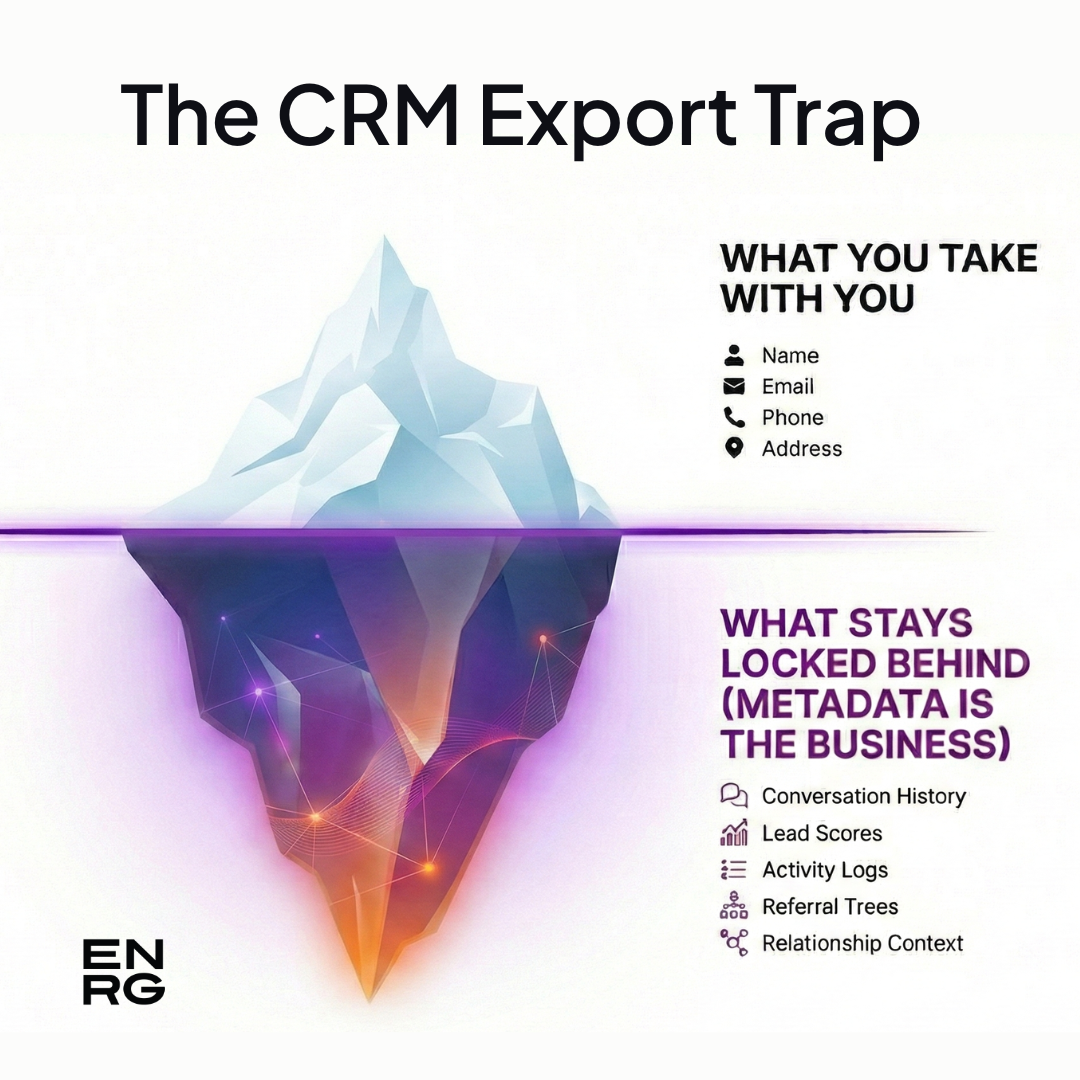
What stays behind has a name.
It's called metadata.
Conversation history. Engagement behavior. Activity timelines. Tags. Lead scoring. Relationship signals.
Metadata is memory. Metadata is meaning. Metadata IS the business.
If you can't take that with you, you don't truly own your database.
And if you don't own your database, do you really own your business?
The Question You Need to Ask Yourself
Agents sell ownership for a living. You help clients build equity. You talk about control, leverage, and long-term wealth.
So here's the question: If ownership is the right choice for your clients, why would renting be the right choice for you?
Data ownership is an option. You just haven't been told it exists.
Once you see that clearly, you can't unsee it.